Our guides
Is Le Marais safe at night?
What official figures and foreign-government advice say about safety in Le Marais, Paris, after dark — and what they do not say. Pickpockets, transport, emergency numbers. Checked October 2026.
Official figures exist by arrondissement, not by neighbourhood, so we give you the 3rd and the 4th and no verdict on the Marais itself. Beyond them, our sources show something narrower, and checkable: none of the foreign authorities we read names the Marais as a hotspot, and the risks they describe in Paris are petty theft, in the metro and the RER and around the big tourist sites. Absence from a warning is not proof of safety, and we do not present it as such.
What the official figures say
The Interior ministry’s statistics office (SSMSI) publishes recorded offences by arrondissement. The Marais is not an administrative unit: it covers the east of the 3rd and 4th arrondissements, so the figures below describe the whole of each arrondissement, not just the Marais. They are 2025 figures, published in the July 2026 edition, and are given per 1,000 residents.
| 2025, per 1,000 residents | 3rd | 4th | Paris |
|---|---|---|---|
| Theft without violence against people (pickpocketing included) | 61.0 | 93.0 | 45.1 |
| Theft with violence but without a weapon | 4.6 | 4.9 | 3.5 |
| Physical violence outside the family | 6.0 | 6.7 | 5.3 |
| Burglary of homes | 7.0 | 5.8 | 5.1 |
In absolute numbers, the 3rd recorded 1,962 thefts without violence and the 4th 2,542, against 94,924 for the whole city.
Read these rates with one reserve: they divide by the resident population, and they do not count visitors, workers or people out at night. In busy central arrondissements the rate is therefore higher than what a resident experiences, and the table is neither a safety ranking nor a measure of the risk to a traveller. Of the 20 arrondissements, the 4th has the fourth-highest rate of theft without violence, behind the 1st (311.6), the 8th (144.3) and the 2nd (118.0); the 3rd is eighth.
For the city as a whole, Paris recorded 94,924 victims of theft without violence in 2025, pickpocketing included. That is 4.2 % fewer than in 2024 (99,110) and 41.5 % fewer than in 2019 (162,378). Thefts with violence but without a weapon fell from 19,141 in 2019 to 7,268 in 2025. These are recorded offences; the figures do not say what happens in the Marais at night.
How the 3rd and the 4th rank among the 20 arrondissements
The SSMSI figures allow a ranking that the headline rates hide. We ranked the 20 arrondissements for each category, from the highest rate to the lowest, using the 2025 data; the ranks are our calculation.
| 2025, per 1,000 residents | 3rd | Rank | 4th | Rank | Highest arrondissement |
|---|---|---|---|---|---|
| Physical violence outside the family | 6.0 | 8th | 6.7 | 5th | 1st (31.0) |
| Theft with violence, no weapon | 4.6 | 8th | 4.9 | 7th | 1st (20.4) |
| Theft without violence | 61.0 | 8th | 93.0 | 4th | 1st (311.6) |
| Burglary of homes | 7.0 | 4th | 5.8 | 10th | 8th (8.8) |
In absolute numbers, the 3rd recorded 193 cases of physical violence outside the family, 149 thefts with violence but without a weapon and 184 home burglaries. The 4th recorded 182, 134 and 133. Both arrondissements are among the top ten of the 20 in every category, the lowest rank being the 4th’s tenth place for burglary. Neither is the highest in any category: the 1st leads three of the four, and the 8th the burglary rate. Those rates remain rates for residents; the two arrondissements receive far more visitors than their resident populations suggest.
What changed since 2019
For Paris as a whole, the SSMSI shows thefts with violence but without a weapon falling from 19,141 in 2019 to 7,268 in 2025, a drop of 62 percent, and thefts without violence falling from 162,378 to 94,924, a drop of 41.5 percent. These are recorded offences for the whole city, not for the Marais. They show a downward trend; they do not show that a given street is safe.
Using the figures for a booking decision
Three practical readings, none of them a verdict.
- Pickpocketing is the category to plan around. It is the largest of the four by far, and the British page places it in the metro, the RER and the big stations, while the Japanese page calls pickpocketing and bag theft very frequent in Paris. The Foreign Office advises not to be distracted around tourist sites and cash machines; none of its warnings is specific to the Marais.
- The airport road. The Korean ministry reports thefts by smashed car windows on the road between Charles-de-Gaulle and Paris, at the Landy tunnel, which concerns a taxi or a hire car rather than the train.
- Check reception hours. Few of our hotels state theirs, and a late arrival at a hotel with a reception that closes at 6.30 p.m. needs a self check-in arrangement agreed beforehand.
What governments advise their travellers
- Japan. The foreign ministry’s page on France, updated on 22 May 2026, shows no risk level in force at 2 October 2026. It calls pickpocketing and theft of bags left unattended very frequent in Paris, with some violent thefts at night, fake police officers, forced sales of souvenirs and the shell game. It names the Eiffel Tower, the Louvre, the Tuileries, the Champs-Élysées and the Trocadéro, and the metro and RER.
- South Korea. France is at level 1 of 4, a call for vigilance, over its whole territory. The ministry reports many pickpockets at tourist sites and in metro stations, and thefts by smashing vehicle windows on the road between Charles-de-Gaulle and Paris, at the Landy tunnel.
- United Kingdom. The Foreign Office page for France, updated on 11 August 2026, warns of pickpockets on the metro, the RER and in the big stations, sometimes in teams where one distracts and the other steals, and advises not to be distracted around tourist sites and cash machines.
None of these pages singles out the Marais. They do point to the transport network, and the Marais sits next to a major interchange: Châtelet–Les Halles, five to ten minutes’ walk from its western edge, where the RER B from Charles-de-Gaulle arrives.
What the Marais looks like after dark
Our descriptions come from the area data, not from police sources. The Marais has two evening lives. Around rue Sainte-Croix-de-la-Bretonnerie and rue Vieille-du-Temple lie the neighbourhood’s LGBT+ bars and restaurants, and rue des Rosiers is car-free and crowded on Sundays. At the other extreme the Île Saint-Louis is residential and quiet in the evening; it counted 2,323 residents in 2016 and has almost no shops outside one street. Our hotels on the Île Saint-Louis compare the four houses there; for the busy side, see the Marais nightlife guide.
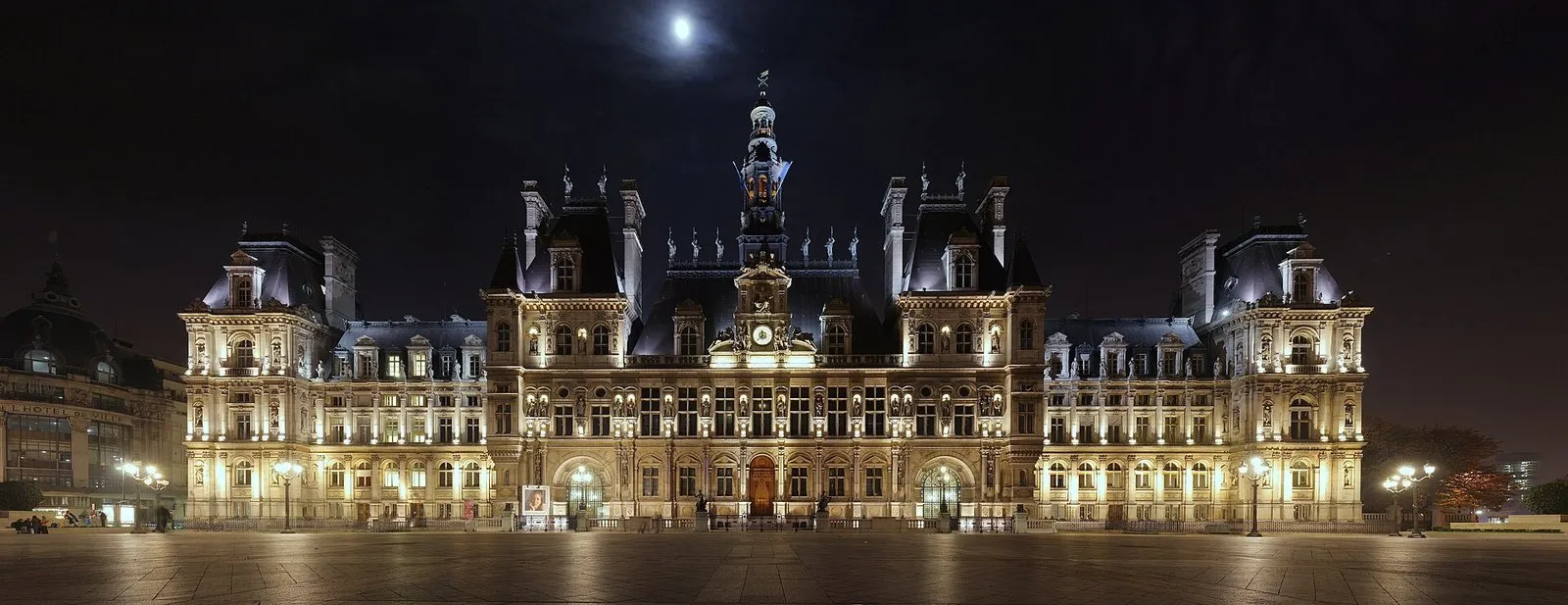
Photo: Benh LIEU SONG, CC BY-SA 3.0, via Wikimedia Commons

Practical steps
- Emergency numbers. 112 is the European emergency number and works across the EU; 17 is the police, 15 the Samu, 18 the fire brigade, and 114 takes text messages for deaf and hard-of-hearing callers. All are free.
- If something is stolen. Foreign visitors can file a free online complaint for a theft where the culprit is unknown, on the French government’s pre-complaint site, which exists in English. For a theft with violence, or an identified culprit, go to a police station.
- Fake police officers. The Paris police prefecture publishes a multilingual guide, Paris en toute sécurité, with a model police card, to help spot them.
- Arrival at night. Check the reception hours before you book. Few hotels in our data state theirs. So’Marais closes its reception at 6.30 p.m. and opens it at 7.30 a.m.; the Hôtel du Haut Marais states 9.30 a.m. to 6.30 p.m. with self check-in by connected lock, according to the hotel.
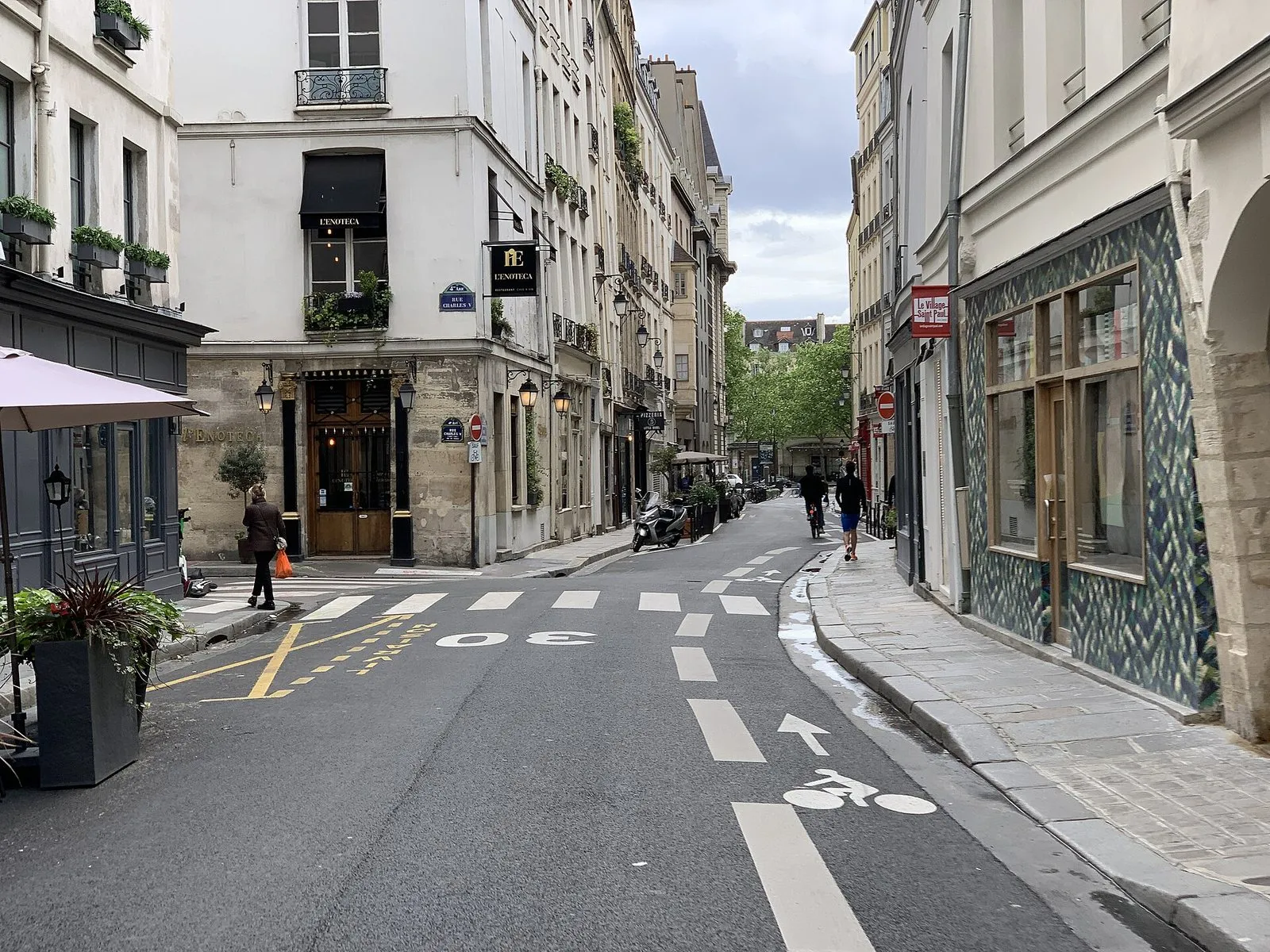
Photo: Chabe01, CC BY-SA 4.0, via Wikimedia Commons

What we cannot tell you
The figures stop at the arrondissement: the SSMSI does not publish below that level, so we have no figure for the Marais alone, none for a given street, and no data on incidents at night. We also hold no reports from guests, whose reviews we do not reproduce. The rates above describe residents’ exposure, not a visitor’s, and we draw no ranking of safe and unsafe areas from them. For the geography of the neighbourhood, see the guide to Le Marais.