Our guides
Le Marais, Paris — the neighbourhood guide
What Le Marais is, where it lies across the 3rd and 4th arrondissements, its eight sub-quarters, metro stations, Sunday opening, 2026 closures and hotels. Checked October 2026.
What the Marais is
Le Marais is the quarter of Paris that spreads across the 3rd and 4th arrondissements. The rue des Francs-Bourgeois, which runs from the place des Vosges to the Rambuteau crossroads, divides it: even numbers are in the 3rd arrondissement, odd numbers in the 4th. Our guides use eight sub-quarters, customary divisions that rest on the administrative quarters. The question of the arrondissement has its own page: which arrondissement is Le Marais in.
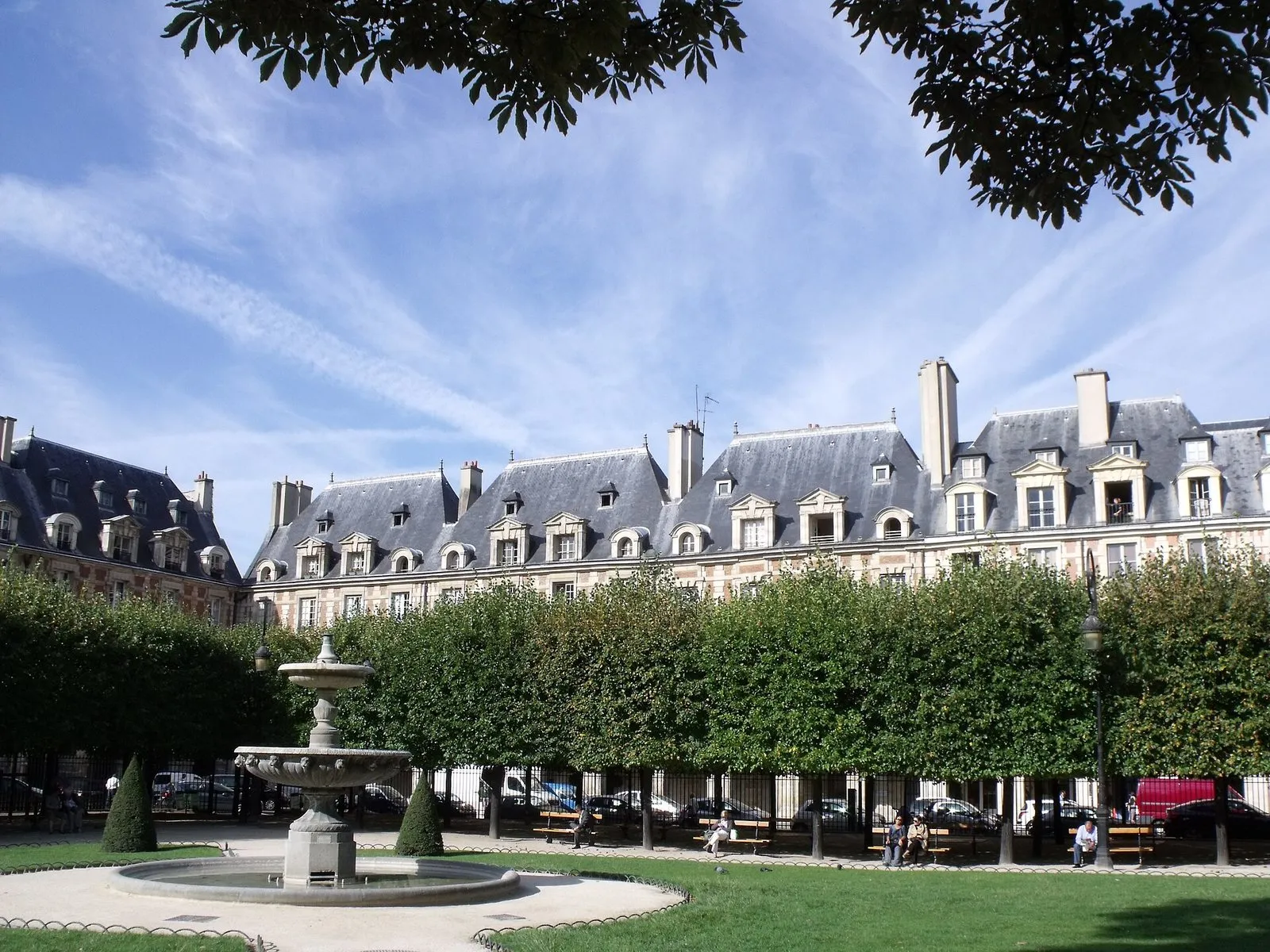
Photo: Alex59300, CC BY-SA 3.0, via Wikimedia Commons

The eight sub-quarters
- Haut-Marais (3rd). North of the rue des Francs-Bourgeois: the Marché des Enfants-Rouges, the Carreau du Temple and the square du Temple, whose lawn is open from 15 April to 15 October. Stations: Filles du Calvaire, Temple, Saint-Sébastien–Froissart, République.
- Arts-et-Métiers (3rd). Around the Cnam and its museum, bordered by busy avenues; the quarter is served by five metro lines within 400 metres of the Cnam. It belongs to no tourist zone.
- Archives (3rd). A high concentration of museums within about 500 metres: the Archives nationales, the Picasso Museum, the Carnavalet, the Cognacq-Jay and the Museum of Hunting and Nature, with the Museum of Jewish Art and History to the west.
- Rosiers (4th). The rue des Rosiers is 303 metres long. The rue Sainte-Croix-de-la-Bretonnerie, 330 metres long, has been the historic core of the LGBT+ Marais since the 1980s. See the rue des Rosiers.
- Saint-Paul (4th). The rue Saint-Antoine, between the Bastille and Saint-Paul, the Village Saint-Paul and the church of Saint-Paul–Saint-Louis; the courtyards and the Célestins quay are much quieter than the rue Saint-Antoine.
- Place des Vosges (3rd and 4th). The place des Vosges, the Maison de Victor Hugo and the Carnavalet Museum.
- Hôtel de Ville and Beaubourg (4th). The sector nearest to Châtelet: the Châtelet metro station (five lines) and Châtelet–Les Halles (RER A, B, D) are five to ten minutes away on foot. The BHV Marais and the Centre Pompidou are here.
- Île Saint-Louis (4th). Residential and quiet, with 2,323 inhabitants in 2016. See the Île Saint-Louis guide.
Photo: Bastenbas, CC BY-SA 4.0, via Wikimedia Commons

What changes in 2026
- Centre Pompidou: closed to the public since 22 September 2025, reopening announced for 2030.
- BHV Marais: at 2 October 2026, open but being restructured; a court decision was expected on 30 October 2026.
- Maison de Victor Hugo: entry ticketed for the whole museum until 22 November 2026.
- Notre-Dame: works around the cathedral continue until 2028 for the most part, with the square Jean-XXIII closed.
- Metro: trains on line 8 do not stop at République from 22 July 2026 to April 2027; lines 3, 5, 9 and 11 still do. Saint-Michel station (line 4) is closed until 19 December, according to paris.fr.
Beyond the museums
Several places of the Haut-Marais and the Arts-et-Métiers quarter need no ticket. The Marché des Enfants-Rouges, at 39 rue de Bretagne, is a listed monument and, according to Wikipedia, often described as the oldest covered market of Paris still in use; the French and English editions of Wikipedia give different creation dates (1615 and 1628), so we give none. The Carreau du Temple, at 2 rue Perrée, is a nineteenth-century covered market turned into a cultural and sports venue, inaugurated in April 2014; its reception is open Monday to Saturday from 10 a.m. to 9 p.m., and the 2026–2027 season began on 1 September 2026. The square du Temple (Élie-Wiesel), created in 1857 on the site of the Templars’ enclosure, has a bandstand of 1900 and a waterfall on Fontainebleau rocks.
The church of Saint-Nicolas-des-Champs, at 254 rue Saint-Martin, was built between 1420 and 1620 in Flamboyant Gothic style and has been a listed historic monument since 10 February 1887. The house of Nicolas Flamel, at 51 rue de Montmorency, is said to be one of the oldest in Paris; it belongs to the neighbouring Sainte-Avoye quarter. The Gaîté Lyrique, at 3 bis rue Papin, is a City of Paris cultural centre, open Tuesday to Friday from 9 a.m. to 10 p.m. and at weekends from 2 p.m. to 7 p.m., and closed on Monday.
Moving around the district
Like the rest of Paris Centre, the Marais is a limited-traffic zone: no through traffic by car, but taxis and ride-hailing cars may set down guests at their hotel. The high quays of the right bank are outside the zone, so traffic continues along the Seine, and the two islands are outside it too. The Hôtel de Ville and Beaubourg sector is the best connected: the Châtelet metro station (five lines) and Châtelet–Les Halles (RER A, B and D) are five to ten minutes away on foot, with the RER B towards Charles de Gaulle and line 14 towards Orly. The Marais has no RER station of its own.
Sunday shopping at a glance
Two Sunday regimes meet at the rue des Archives. East of it, the “Le Marais” tourist zone covers the Archives quarter, the place des Vosges, the rue des Rosiers, the Village Saint-Paul and, on the Île Saint-Louis, the rue Saint-Louis-en-l’Île, but not the quays. West of it, the “Les Halles” zone covers the BHV and Beaubourg. The Arts-et-Métiers quarter and the Hôtel de Ville building itself are in neither. Details are in Le Marais on Sunday.
Choosing a first day
A first day can follow the museum cluster of the Archives quarter, which sits within about 500 m: the self-guided walking tour links it with the place des Vosges and the island in 3.8 km. A second day can turn to the Haut-Marais, with the market, the Carreau du Temple and the galleries; a third to the food, with falafel, brunch and the food tours. The history that explains the streets is in the history of Le Marais.
Where to stay
Our database holds 70 hotels in the quarter, classified by Atout France: 8 five-star, 22 four-star, 29 three-star, 6 two-star and 2 one-star, with 3 unclassified. By sub-quarter: Arts-et-Métiers 18, Saint-Paul 16, Hôtel de Ville 11, Haut-Marais 10, place des Vosges 4, Rosiers 4, Île Saint-Louis 4 and Archives 3. The comparisons are on hotels in the 3rd arrondissement, hotels in the 4th, luxury hotels and cheap hotels; the sector pages are hotels near the place des Vosges, rue Saint-Paul, rue des Rosiers and the Hôtel de Ville.
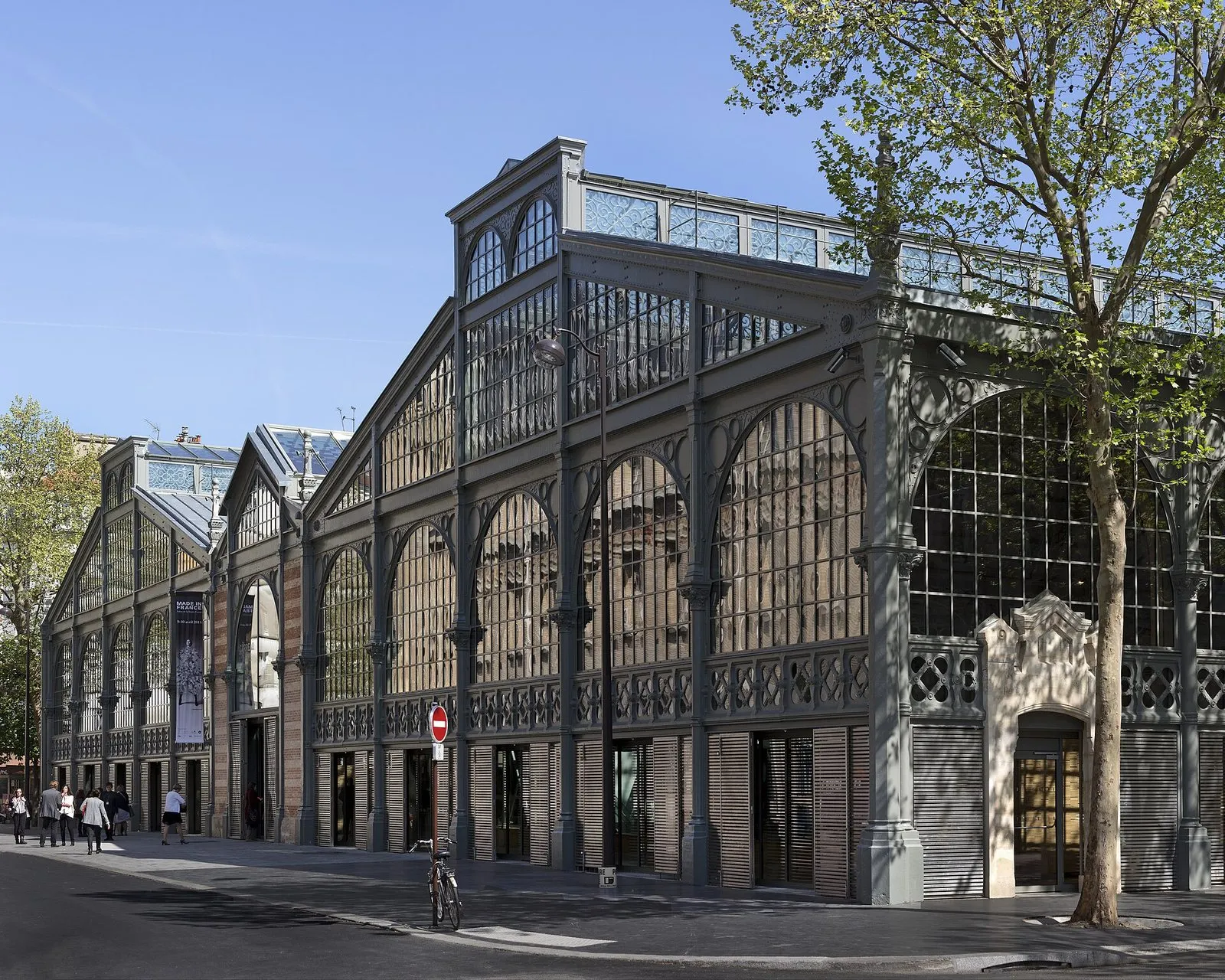
Photo: Carreau du Temple, CC BY-SA 4.0, via Wikimedia Commons

History and distinctive features
- The rue des Francs-Bourgeois runs from the place des Vosges to the Rambuteau/Archives crossroads and marks the limit between the 3rd arrondissement (even numbers) and the 4th (odd numbers). Source : fr.wikipedia.org
- The international tourist zone “Le Marais” lets shops open on Sundays and until midnight, subject to a collective agreement. Not every street is inside it; the Arts-et-Métiers quarter is in no tourist zone. Source : legifrance.gouv.fr
- Paris Centre is a limited-traffic zone: no through traffic by car, but taxis and ride-hailing cars may drop guests at their hotel. The upper quays of the right bank and the Grands Boulevards are excluded. Source : paris.fr
- The Marché des Enfants-Rouges, at 39 rue de Bretagne, is a covered market listed as a historic monument and often described as the oldest in Paris still in service. Source : fr.wikipedia.org
- The Carreau du Temple, at 2 rue Perrée, is a nineteenth-century covered market turned into a cultural and sports venue in April 2014. Its reception is open Monday to Saturday from 10 a.m. to 9 p.m., and its 2026–2027 season resumed on 1 September 2026. Source : carreaudutemple.eu
- The Village Saint-Paul is a micro-quarter of about one hectare: ten gateways open onto six courtyards linked by a pedestrian route. Source : fr.wikipedia.org
- The rue des Rosiers has been pedestrian on Sundays since 2006, and is then very busy; on weekdays it stays lightly trafficked. Source : fr.wikipedia.org
Frequently asked questions
What is Le Marais in Paris?
A quarter of the right bank of the Seine, spread over the 3rd and 4th arrondissements. The rue des Francs-Bourgeois separates them: even numbers belong to the 3rd, odd numbers to the 4th. The place des Vosges, the oldest square in Paris, straddles the two.
Which arrondissement is Le Marais in?
Both the 3rd and the 4th. The pavillon de la Reine, on the place des Vosges, is in the 3rd, while the nos. 6 and 19 of the same square are in the 4th.
Can I shop in Le Marais on Sunday?
In large part, yes: much of the quarter is in the international tourist zone “Le Marais”, where shops may open on Sundays and until midnight. The Arts-et-Métiers quarter and the quays are outside it.
Which metro stations serve Le Marais?
Among others Saint-Paul (line 1), Hôtel de Ville (lines 1 and 11), Rambuteau (line 11), Chemin Vert and Bastille (line 8, and lines 1 and 5 at Bastille), Filles du Calvaire (line 8), Temple (line 3), Arts et Métiers (lines 3 and 11) and République (lines 3, 5, 8, 9, 11; trains on line 8 skip République from 22 July 2026 to April 2027).
Can I still visit the Centre Pompidou?
Not the building. It has been closed to the public since 22 September 2025 and is due to reopen in 2030; its programme continues outside its walls.
Can I drive in Le Marais?
There is no through traffic by car, because Paris Centre is a limited-traffic zone, but taxis and ride-hailing cars may drop guests at their hotel.
Is the Marais quiet in the evening?
It depends on the sector. The Île Saint-Louis is residential, with almost no shops outside the rue Saint-Louis-en-l'Île, and quiet in the evening. Around the rue Sainte-Croix-de-la-Bretonnerie and the rue Vieille-du-Temple there are LGBT+ bars and restaurants. The Hôtel de Ville sector is the nearest to Châtelet–Les Halles.
What is the Marché des Enfants-Rouges?
A covered market at 39 rue de Bretagne, often described as the oldest in Paris still in use, according to Wikipedia. Its creation date differs between sources (1615 or 1628).
Is there an RER station in Le Marais?
No. The RER B towards Charles de Gaulle and line 14 towards Orly are reached at Châtelet, five to ten minutes on foot from the western edge of the district.
How should I plan three days in Le Marais?
One day for the museum cluster of the Archives quarter and the walking tour, one for the Haut-Marais with its market and galleries, and one for the food addresses, as laid out above.