Saint-Paul
Village Saint-Paul, Paris
The Village Saint-Paul in Le Marais — about 80 antique and design shops around six courtyards, opening hours, the 2026 renovation works, metro and nearby hotels. Checked October 2026.
What the village is
Between rue Saint-Paul, rue Charlemagne, rue des Jardins-Saint-Paul and rue de l’Ave-Maria, in the 4th arrondissement, a whole block is a set of linked courtyards rather than a street. You enter under a porch from the street and come out into a yard lined with small shops. The line 1 station that gives it its name is the nearest metro stop.
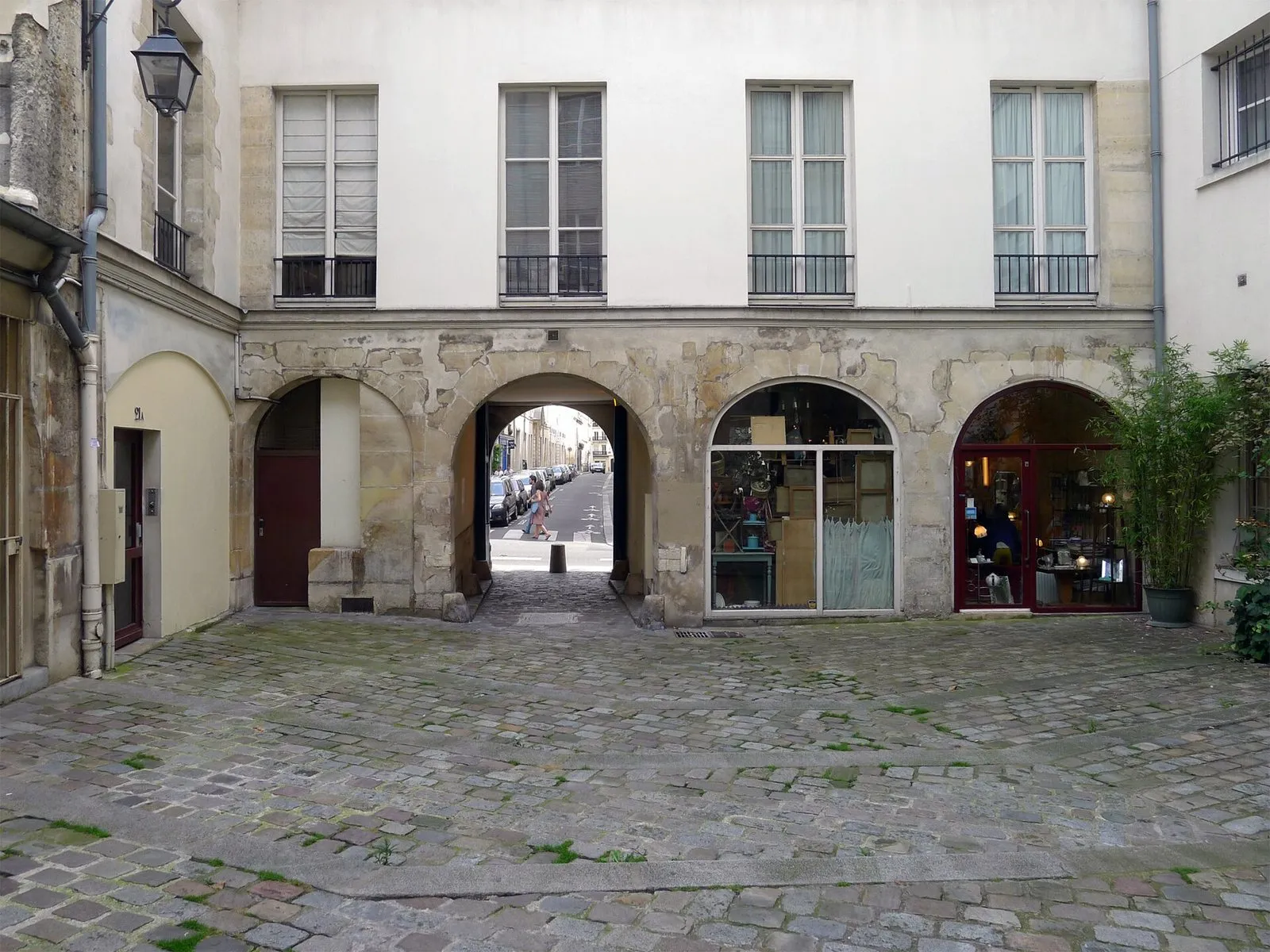
Photo: Mbzt, CC BY-SA 4.0, via Wikimedia Commons

The trade is specialised: roughly 80 businesses selling antiques, second-hand goods, design and craft work, with restaurants and tea rooms between them. For a wider look at buying old furniture and clothes in the district, see vintage shops in Le Marais.
Works in 2026
The village is open, but it is a building site in places. On its official page, the landlord RIVP says it is carrying out the renovation of all the buildings and interior courtyards. It gives no end date. In practice, allow for scaffolding and altered passages. Opening hours, which the website gives as 9 a.m. to 7 p.m. depending on the trader, are the only schedule we can quote.
A short history
The site was once the royal residence of Charles V, the hôtel Saint-Pol. Rue des Lions-Saint-Paul keeps the memory of the menagerie. The present village came out of a clearance operation in the early 1980s, within the protected area created by the Malraux law of 1962. Our history of Le Marais places this episode in the longer story of the district.
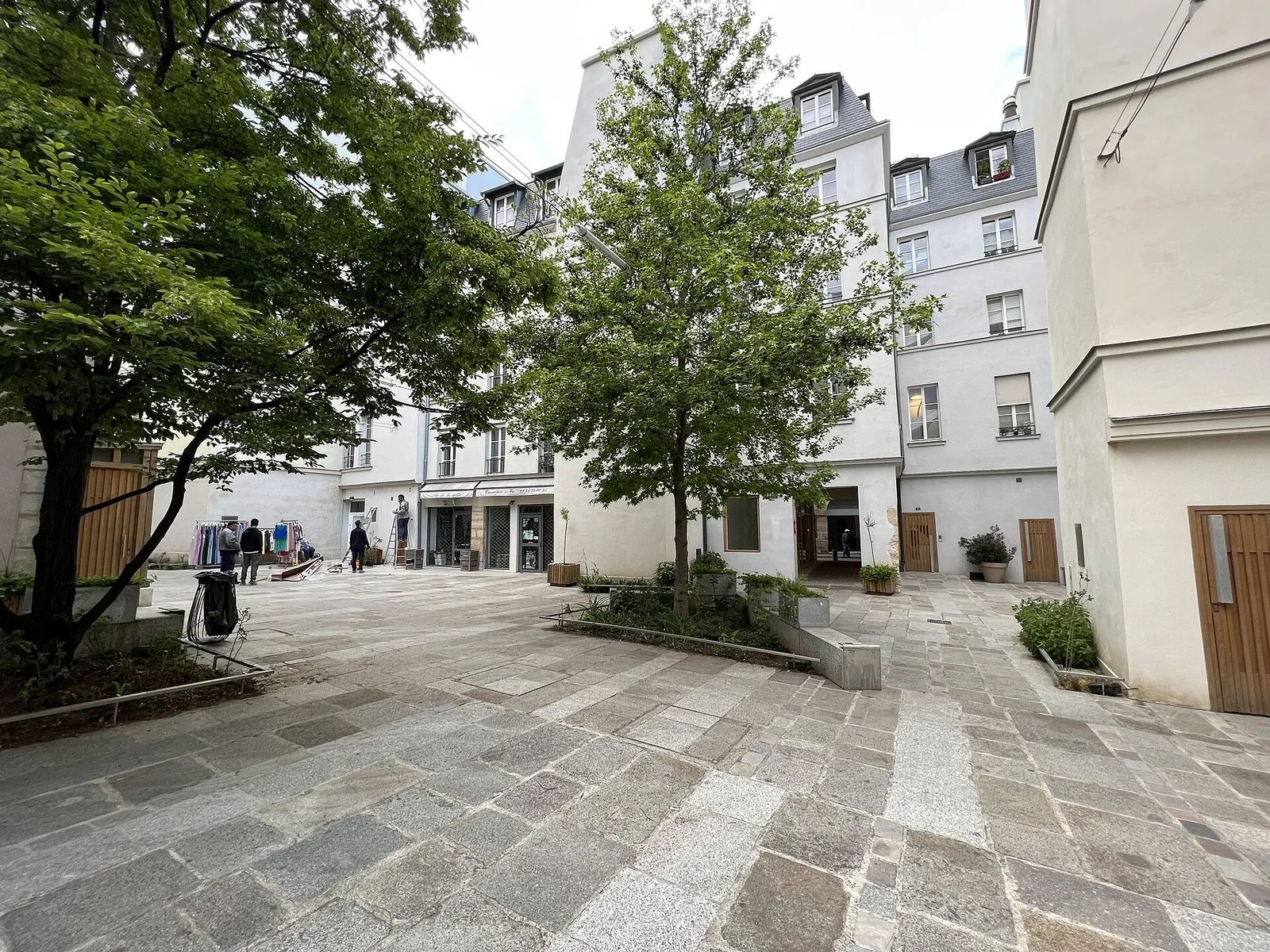
Photo: Chabe01, CC BY-SA 4.0, via Wikimedia Commons

Getting there
Line 1 to Saint-Paul is the simplest approach, 188 metres from the middle of the block. Line 7 serves Sully-Morland and Pont Marie. Bastille, about 510 metres away, adds lines 5 and 8. Distances are straight-line figures from Île-de-France Mobilités data. The Centre Pompidou, nearby, is closed for renovation; its reopening is announced for 2030.
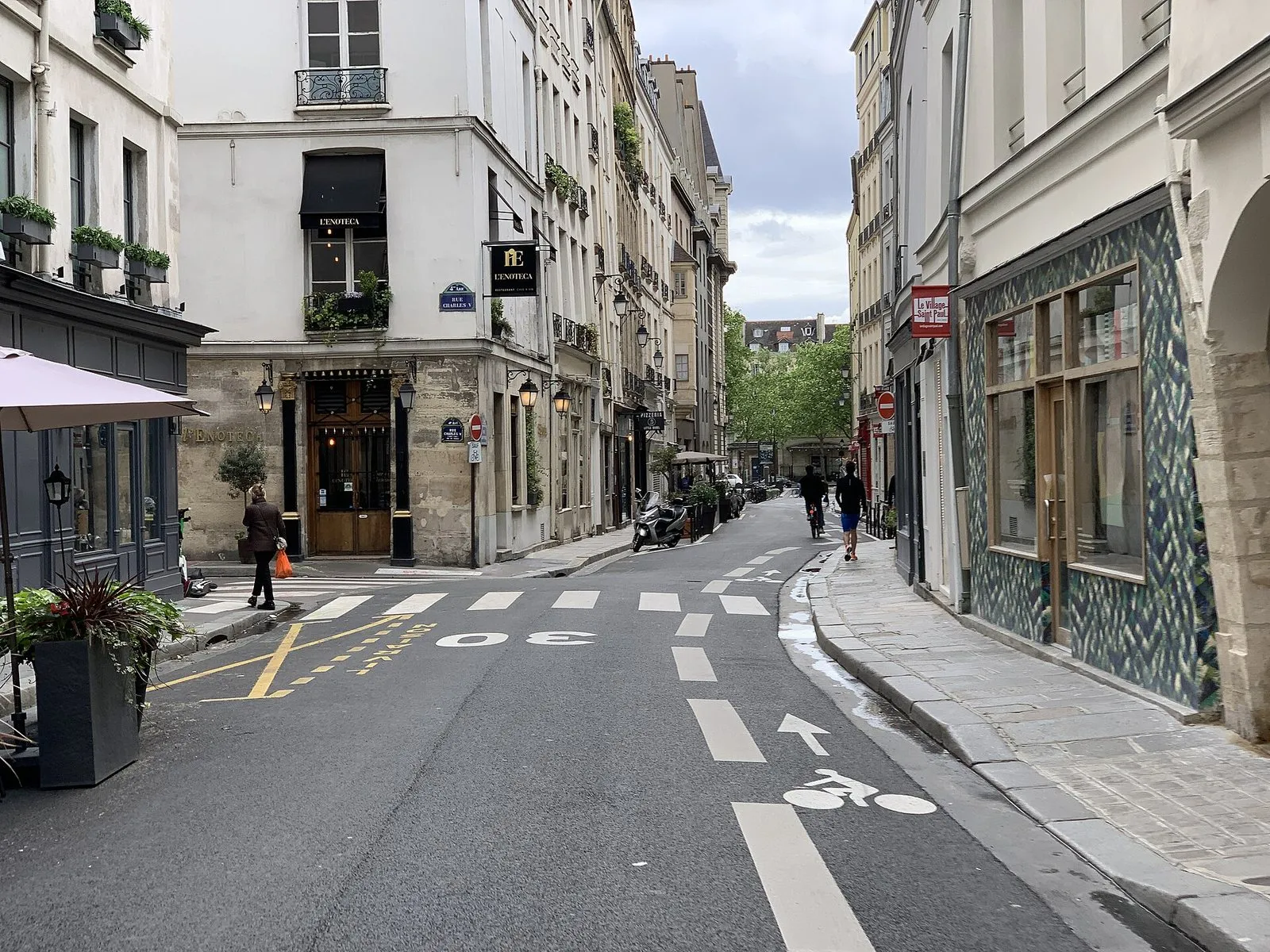
Photo: Chabe01, CC BY-SA 4.0, via Wikimedia Commons

A site with a long memory
The Village Saint-Paul says that its site has been built over for centuries. The rue Saint-Paul joined the riverbank to a cemetery founded in 633 by Saint Eloi for the nuns of the island monastery. Around 1200 Philippe Auguste had a fortified wall built. In 1360 Charles V began to install the Hôtel Saint-Pol there, a group of houses and gardens, which was dismantled around 1550; the rue des Lions-Saint-Paul recalls his royal menagerie. The church of Saint-Paul disappeared during the Revolution.
In the twentieth century, in the 1920s, the site was classified as “îlot insalubre no. 16”, an unhealthy block of 14 hectares. In 1941 the préfecture de la Seine carried out a wave of expropriations and expulsions. The Malraux law of 1962 opened the way to protected sectors, that of the Marais being set up in 1964, and the Village was born in the early 1980s from an operation of clearing and restoration. The village’s own site gives about 80 shops, a figure we also use above.
Buses and what the village does not say
The village names the Saint-Paul station on line 1 and the Pont Marie and Sully-Morland stations on line 7, and the bus lines 67, 69, 72, 76, 86, 87 and 96. Its site says nothing about parking, toilets, access for people with reduced mobility, or the date of an antiques fair, so we state none. For those points, contact the shops directly or the landlord, the RIVP.
How the village is laid out
According to Wikipedia, the Village Saint-Paul covers about one hectare. Ten entrance porches lead in from four streets: four on rue Saint-Paul, three on rue des Jardins-Saint-Paul, two on rue Charlemagne and one on rue de l’Ave-Maria. Six interior courtyards are linked by pedestrian routes, so a visit is a walk from court to court rather than along a street. A section of the wall of Philippe Auguste stands along the rue des Jardins-Saint-Paul, and the village lies inside the protected sector of the Marais, set up in 1964.
The streets around the village
The rue des Jardins-Saint-Paul is 175 metres long and 9 metres wide, from the quai des Célestins to the rue Charlemagne, according to Wikipedia. It was opened in the thirteenth century on gardens next to the fortifications, and received its official name in 1847. It keeps a section of the Philippe Auguste wall 60 metres long and 7.6 metres high, built between 1190 and 1220, with two towers, one of them the Montgomery tower at the corner of the rue Charlemagne. The odd numbers 5 to 21 were demolished in 1946 within the unhealthy block no. 16; numbers 6 to 28 were rehabilitated in the 1970s by the architect Félix Gatier, and the Charlemagne fountain of 1840 stands at no. 26.
At the end of the rue Charlemagne, at no. 14, the lycée Charlemagne occupies the former professed house of the Jesuits, built between 1627 and 1647 next to the church. After the Jesuits were expelled between 1762 and 1767, the public library of Paris was housed there from 1773 to 1790, the central school of the rue Saint-Antoine opened in 1797, and the school took its present name in 1804. Remains of the Philippe Auguste wall can be seen near its junior school. The lycée is a working school, not a sight.
The renovation and who lives here
The block was renewed from 1970 to 1985 under the architect Félix Gatier, according to Wikipedia. It now counts 80 boutiques at ground level and 243 social-housing units; the average apartment grew from 28 square metres before 1971 to 56 square metres after the renovation. The village therefore remains a residential block with shops, not a purely commercial one.
Choosing your moment
The courtyards are open to everyone, with no ticket. The village gives hours of 9 a.m. to 7 p.m. depending on the trader, Monday to Sunday, and shops and restaurants are open on Sunday. Each shop sets its own hours, and many open around 11 a.m.; we have not checked them one by one, so a visit after noon is safer. The refurbishment announced by the landlord may put up scaffolding and change some passages.
Combining the visit with a walk
The figures from the village are straight-line distances between our coordinates; the times apply a 1.3 detour factor at a pace of 80 metres a minute.
- Saint-Paul-Saint-Louis church: 125 metres, about 3 minutes.
- Hôtel de Sully: 165 metres, about 3 minutes.
- Place des Vosges: 332 metres, about 6 minutes.
- Maison de Victor Hugo: 345 metres, about 6 minutes.
- Carnavalet Museum: 388 metres, about 7 minutes.
- Shoah Memorial: 422 metres, about 7 minutes.
Where to stay nearby
The hotels below are calculated from their coordinates and sorted by distance. For the full list around the same streets, see hotels near rue Saint-Paul.
History and distinctive features
- About 80 shops, mostly antiques, second-hand dealers, design and the crafts, plus restaurants and tea rooms. Source : levillagesaintpaul.com
- The village dates from the early 1980s, when the block was cleared out under the Marais protected-area scheme (the Malraux law of 1962). It stands on the site of Charles V's royal residence, the hôtel Saint-Pol, where rue des Lions-Saint-Paul recalls the royal menagerie. Source : levillagesaintpaul.com
- According to Wikipedia, the village covers about one hectare between rue Charlemagne, rue Saint-Paul, rue de l'Ave-Maria and rue des Jardins-Saint-Paul, with ten covered entrances leading to six courtyards. Source : fr.wikipedia.org
Hotels near the Village Saint-Paul
Other hotels
- Hôtel Charles V ★★★★ 1 min walk · 50 m
- Hôtel De Neuve by HappyCulture ★★★ 2 min walk · 150 m
- Hôtel Caron Le Marais ★★★ 3 min walk · 200 m
- Pratic Hôtel ★★ 3 min walk · 250 m
- Hôtel Saint-Louis Marais ★★★ 3 min walk · 250 m
- Hôtel Emile ★★ 3 min walk · 250 m
Within 450 m as the crow flies, nearest first. Walking times are estimates: straight-line distance × 1.3, at 80 metres a minute, to the station, not to a specific exit.
Frequently asked questions
Is the Village Saint-Paul open in 2026?
Yes. The official website, read on 2 October 2026, gives hours from 9 a.m. to 7 p.m. depending on the shop, seven days a week. It also says that the landlord, the City's housing company RIVP, is renovating all the buildings and courtyards.
How long will the works last?
No timetable is published on the website. Expect scaffolding and altered passages, and check the page before making a special trip.
Is it free to enter?
Yes. The courtyards are free to enter and walk through; you pay only in the shops, tea rooms and restaurants.
Which metro station is closest to the Village Saint-Paul?
Saint-Paul, on line 1, about 188 metres away. Sully-Morland and Pont Marie, both on line 7, are 225 and 338 metres away, as the crow flies.
Can I shop there on a Sunday?
The village website says shops are open on Sundays, with hours set trader by trader. Our page on the Marais on Sundays explains the legal frame.
How many courtyards does the Village Saint-Paul have?
Six interior courtyards, reached through ten porches from four streets, according to Wikipedia.
Are the shops of the Village Saint-Paul open on Sunday?
Yes, according to the village, shops and restaurants are open on Sunday; hours run from 9 a.m. to 7 p.m. depending on the trader, and each shop sets its own.
Is the Philippe Auguste wall visible in the village?
Yes, a section 60 metres long and 7.6 metres high, dating from 1190 to 1220 with two towers, stands along the rue des Jardins-Saint-Paul, according to Wikipedia.
How long does a visit to the Village Saint-Paul take?
The village publishes no visit time. Its six courtyards, about one hectare in all according to Wikipedia, can be crossed in a few minutes; the time you spend depends on the shops.
Which bus lines stop near the Village Saint-Paul?
The village names the bus lines 67, 69, 72, 76, 86, 87 and 96, together with the Saint-Paul, Pont Marie and Sully-Morland metro stations.