Our guides
From Le Marais to the Eiffel Tower
How long it takes to reach the Eiffel Tower from Le Marais by metro, from two starting points, with the routes and the hotels near line 9. Checked October 2026.
Allow 37 to 40 minutes by metro from the middle of Le Marais to the Eiffel Tower. From the place des Vosges that is about twice the time to the Louvre or Notre-Dame, and the longest of the three journeys we timed from the district.
The two timed journeys
Our figures come from the Île-de-France Mobilités timetables: the median of departures between 10:00 and 10:15 on a Tuesday, with the walk to the first station included. We timed two starting points, one in the south of the Marais and one in the north.
| From | To the Eiffel Tower | Route |
|---|---|---|
| Place des Vosges | 37 to 38 minutes | Walk to Saint-Paul; line 1 to Franklin D. Roosevelt; change; line 9 to Iéna |
| Rue de Bretagne (Haut-Marais) | 38 to 40 minutes | Walk to Oberkampf; line 9 straight to Iéna |
Both journeys end at Iéna, on line 9, and both depend on line 9. The northern route takes a few minutes longer but needs no change; the southern one is shorter but has one change, at Franklin D. Roosevelt, where lines 1 and 9 meet.
For comparison, from the same two starting points:
| From | Louvre | Notre-Dame |
|---|---|---|
| Place des Vosges | 17 minutes | 18 to 19 minutes |
| Rue de Bretagne | 22 to 25 minutes | 21 to 23 minutes |
So the tower costs about 18 to 20 minutes more than the other two sights from the place des Vosges, and about 18 from the Haut-Marais.
Which part of the Marais is best placed
Only two starting points were timed, so we cannot give a minute count for every street. Our station data helps for a first selection. Line 9 serves République, Oberkampf and Strasbourg–Saint-Denis, three stations on the northern edge of the Marais or just beyond it; a hotel near one of them starts the trip on the same line as the rue de Bretagne route.
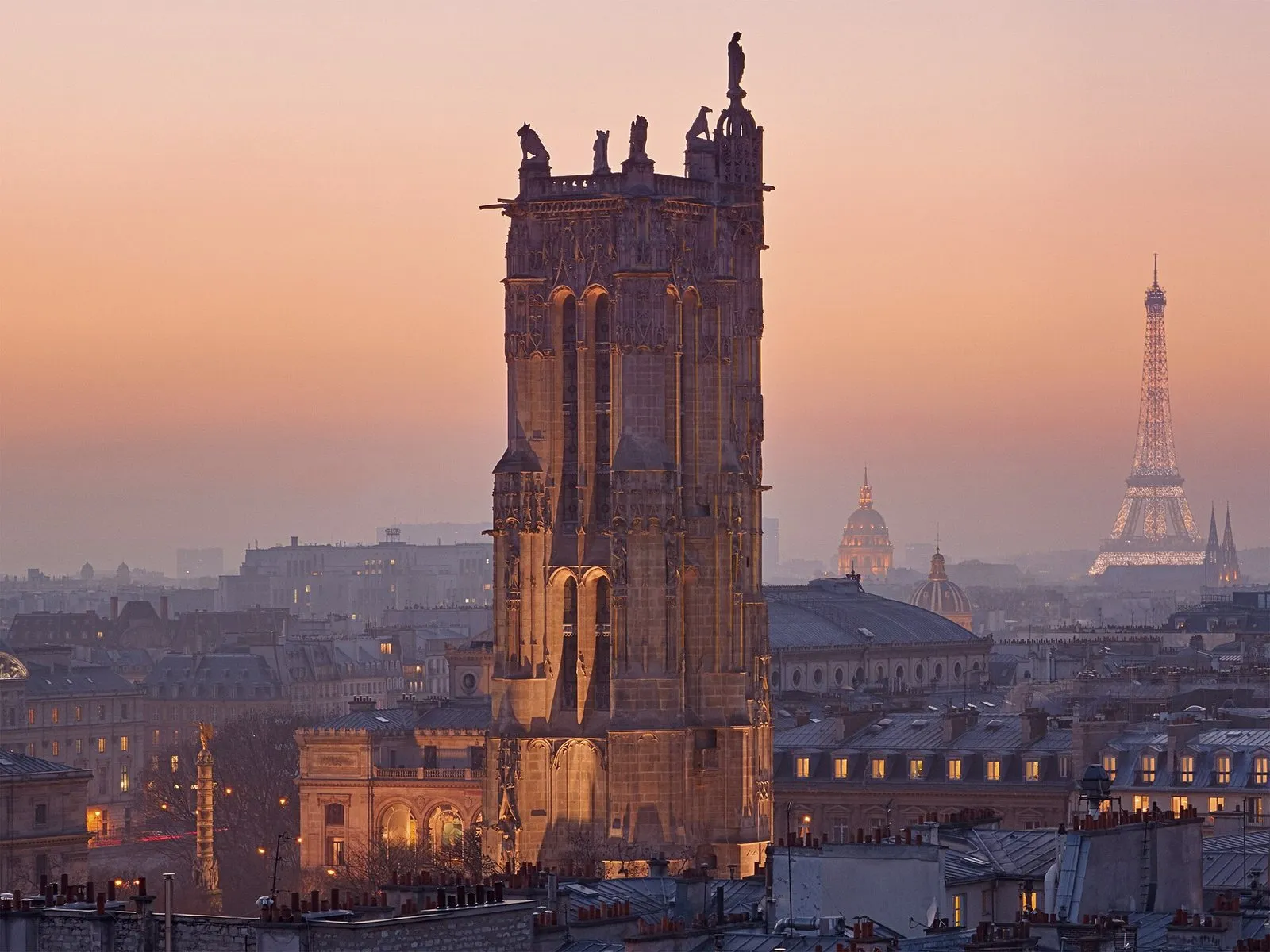
Photo: Fabien Barrau, CC BY-SA 4.0, via Wikimedia Commons

- Within five minutes on foot of Oberkampf (lines 5 and 9): 1K Paris, three minutes, and Hôtel Américain, four.
- Within five minutes on foot of République (lines 3, 5, 8, 9 and 11): Hôtel Meslay République and Hôtel Paris Bruxelles, one minute each, Le Relais du Marais, three, and Paris France Hôtel and Hôtel Américain, four. Line 8 does not stop at République from 22 July 2026 to April 2027 because of works; lines 3, 5, 9 and 11 still do.
- Within five minutes on foot of Strasbourg–Saint-Denis (lines 4, 8 and 9): Hôtel Marais Grands Boulevards, one minute, Hôtel du Plat d’Étain, two, and Solly Hôtel, three.
These hotels are listed by station, not timed to the tower; we have not computed the exact minutes from them. Hotels near Saint-Paul and the south, on line 1, are on the place des Vosges route, with its one change.
Seeing the tower without going there
Two hotels in our database mention the tower as a view from their rooms. At SO/ Paris, in the sixteen-floor Morland building facing the Île Saint-Louis, the MICHELIN Guide says that more than half of the rooms face the Eiffel Tower. At Solly Hôtel, a room category called Cosy vue Tour Eiffel exists, according to the hotel; other rooms have balconies over the Gaîté Lyrique theatre and the rooftops. Neither hotel promises the view for every room, so ask for it when booking.
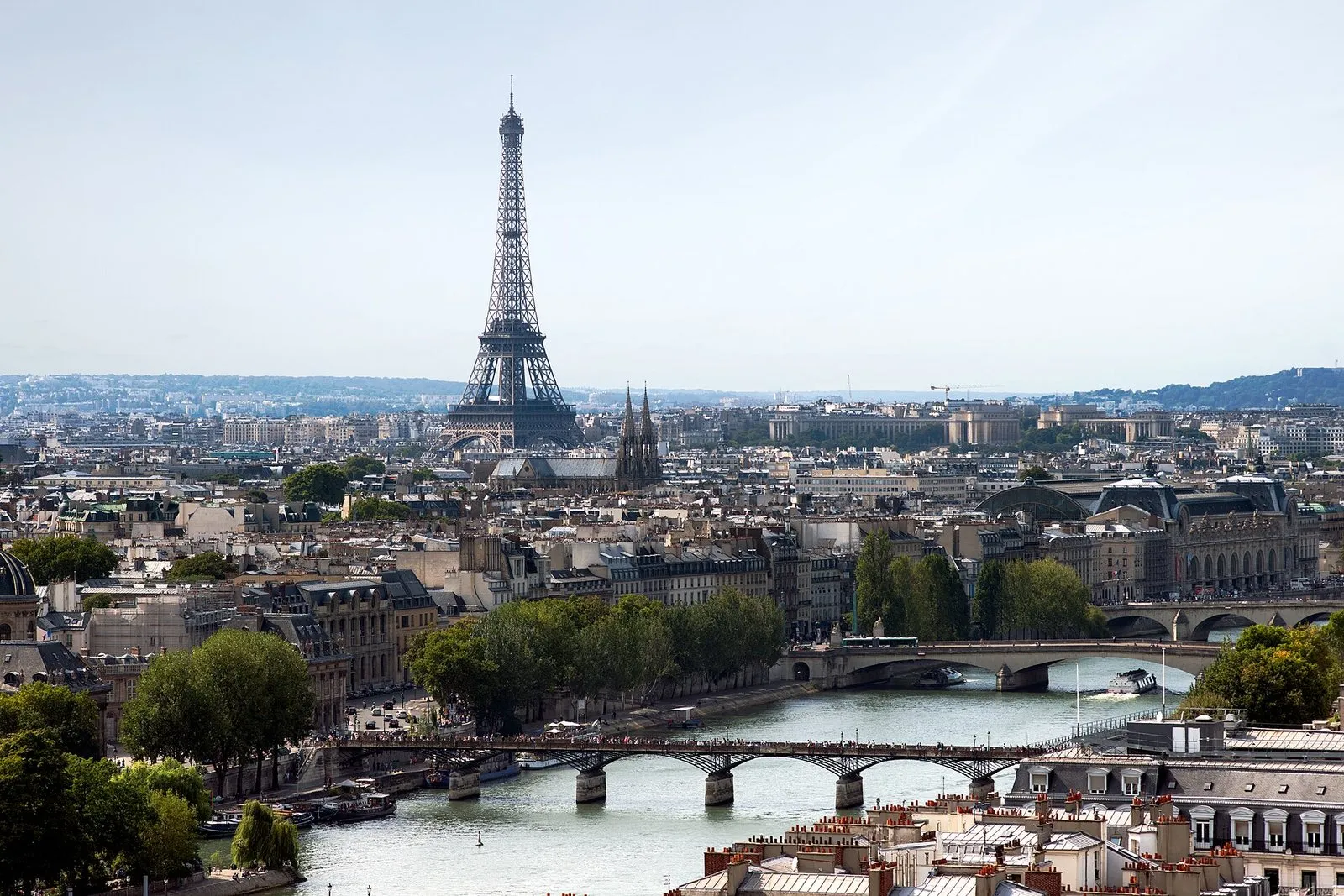
Photo: ThePromenader, CC BY-SA 3.0, via Wikimedia Commons

The tower in figures
According to Wikipedia, the Eiffel Tower is 330 metres high with its antennae (2022 measurement), and 279.11 metres to the highest public platform. Gustave Eiffel’s company built it from 1887 to 1889, with the engineers Maurice Koechlin and Émile Nouguier and the architect Stephen Sauvestre, and it was inaugurated on 31 March 1889 for the Exposition universelle.
The public levels are the first at 57.63 metres, the second at 115.73 metres and the top at 276.13 metres. The stairs have 1,665 steps in all, but the public may use them only as far as the second level. The structure assembles 18,038 pieces of puddled iron with 2.5 million rivets. The tower received 6.2 million visitors in 2017 and more than 300 million since it opened, according to Wikipedia. We could not read the official ticketing pages when we checked, so we give no opening hours or prices here; the tower’s own site is the reference.
Other ways to arrive
Our timed route ends at Iéna, on line 9. Wikipedia names the RER C station Champ de Mars–Tour Eiffel as the rail station for the tower. We have not timed it from the Marais, and we have not timed the walk from any of the stations to the foot of the tower; the minutes above should be read as the metro journey, not as the whole trip.
Arriving in Paris first
The same method gives journey times from the airports to the middle of the Marais. From the place des Vosges, Orly takes a median of 40 minutes (38 to 41), by line 14 to Gare de Lyon and line 1 to Bastille. Roissy–Charles-de-Gaulle takes 55.5 minutes from Terminal 1 (53 to 58) and 60.5 minutes from Terminal 2 (56 to 68), by the RER B to Gare du Nord and line 5 to Bréguet-Sabin. To the rue de Bretagne in the Haut-Marais, the figures are 46.5 minutes from Orly, 54.5 from Terminal 1 and 59.5 from Terminal 2.
There is no RER station in the Marais itself, according to Île-de-France Mobilités: the RER B reaches Châtelet–Les Halles or Gare du Nord, where the metro takes over, and line 14 from Orly reaches Châtelet or Gare de Lyon. The times are theoretical, outside disruptions, security queues and ticket-office waits.
How the three journeys compare
Using the medians above, the tower takes 2.2 times as long as the Louvre from the place des Vosges (37.5 minutes against 17) and 2.0 times as long as Notre-Dame (against 19). From the rue de Bretagne the ratios are 1.8 (40 minutes against 22.5) and 1.9 (against 21.5). The gap is therefore similar from both ends of the Marais.
How many hotels sit near each line
We counted, in our base of 70 hotels, those with a station within five minutes’ walk, using the walking times in their files (straight-line distance × 1.3, at 80 metres a minute). A hotel with several stations counts once for each line.
| Line | Hotels within 5 minutes of a station |
|---|---|
| 11 | 27 |
| 1 | 26 |
| 3 | 21 |
| 8 | 21 |
| 5 | 13 |
| 7 | 13 |
| 4 | 10 |
| 9 | 9 |
| 14 | 2 |
For the Eiffel Tower, two lines matter. Line 9, which our rue de Bretagne route uses without a change, has only nine hotels within five minutes, against 26 for line 1, which our place des Vosges route uses with one change at Franklin D. Roosevelt. No hotel is within five minutes of both lines, and 35 of the 70 are within five minutes of neither. Those hotels need a walk to a station of one of the two lines, or a change; we have not timed those routes.
The busiest stations in this count are Saint-Paul, with 15 hotels, Arts et Métiers with 13, Hôtel de Ville and Temple with 8 each, and Réaumur–Sébastopol and Pont Marie with 7.
What we did not measure
The timings are for a weekday morning. We have no figures for evenings, weekends or days of metro disruption, and no walking time from Iéna station to the foot of the tower. We have not timed a taxi. The tower is also one of the sites that foreign governments name for pickpocketing in Paris: see is Le Marais safe at night, which gives their advice.
If the distance matters to you, compare the sectors of the neighbourhood in the guide to Le Marais, and choose between the two arrondissements with hotels in the 3rd arrondissement and hotels in the 4th arrondissement.