Our guides
The Jewish quarter of Paris in Le Marais
The Jewish quarter of Paris, the Pletzl — its boundaries, rue des Rosiers, the rue Pavée synagogue, a hidden garden, Shabbat and Sunday rhythms, metro and nearby hotels. Checked October 2026.
The limits of a customary quarter
The Jewish quarter of the Marais has no administrative border: it is a customary division within the north of the Saint-Gervais district. It runs between rue des Francs-Bourgeois to the north and rue de Rivoli to the south, from rue Vieille-du-Temple and rue du Temple on the west to rue Malher and rue Pavée on the east. Its heart is rue des Rosiers, 303 metres where some 20,000 Eastern European Jews settled between 1881 and 1914, according to Wikipedia; falafel has been associated with it since 1979, and fashion and luxury shops have gradually replaced the traditional businesses since the 1980s.
What to see
- Rue des Rosiers. Synagogues, a bakery, bookshops and falafel counters; explore it with our guide to the street and our page on falafel in Le Marais.
- The rue Pavée synagogue. An Art Nouveau façade signed Hector Guimard, from 1913.
- Jardin des Rosiers–Joseph-Migneret. A garden hidden in the middle of the block, between rue des Rosiers and rue des Francs-Bourgeois.
- Hôtel de Lamoignon. The Hôtel d’Angoulême-Lamoignon, at 24 rue Pavée, houses the Bibliothèque historique de la Ville de Paris; Saint-Paul station is about 200 m away.
- The Shoah memorial. See our guide to the Memorial.
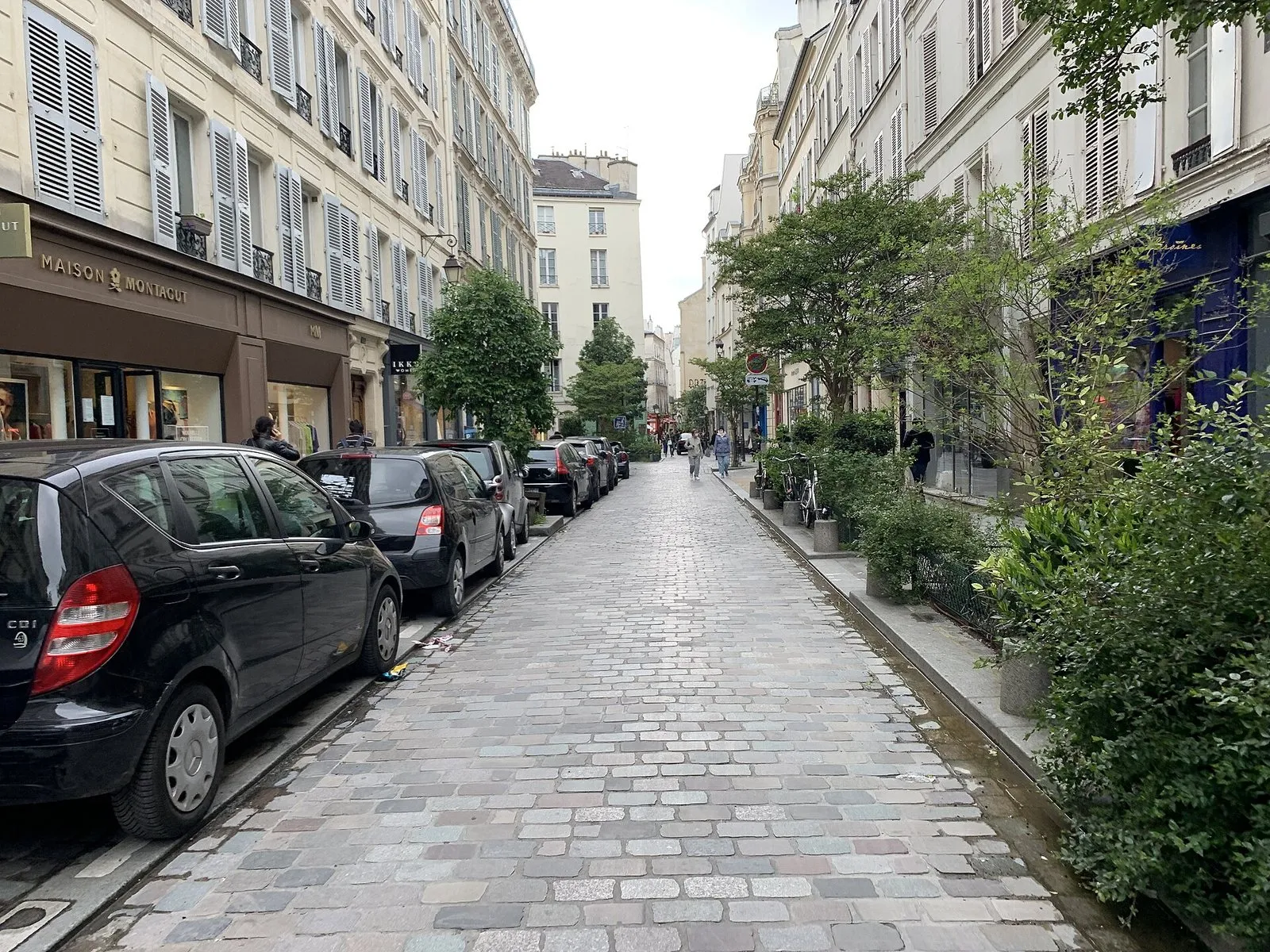
Photo: Chabe01, CC BY-SA 4.0, via Wikimedia Commons

A short history of the quarter
According to Wikipedia, a Jewish presence is recorded here from the thirteenth century, in a street first called the rue des Juifs, which became the rue Ferdinand-Duval in 1900. “Pletzl”, the quarter’s nickname, is Yiddish for “little square”, and refers to the place Saint-Paul area. Ashkenazi Jews fleeing persecution reached France in growing numbers from 1881, most of them Yiddish speakers from Romania, Russia and Austria-Hungary.
The synagogue on the rue Pavée, built by Hector Guimard in 1913, was dynamited on the night of 2 to 3 October 1941, during the Yom Kippur vigil, by far-right collaborators, and partly restored afterwards. It was listed as a historic monument on 4 July 1989 and is the only religious building Guimard designed; it is not open for regular visits, but opens on special occasions such as the Heritage Days. It is 10 rue Pavée, on a plot only 5 metres wide and 23 long, which explains the 12-metre façade raised on narrow windows and continuous pilasters. During the Vél’ d’Hiv roundup of 16 July 1942, arrests were made in the quarter, and 165 pupils of the primary school of the Hospitalières-Saint-Gervais died in the Nazi camps. For the names and the history in detail, the Shoah Memorial is 346 metres from the middle of the rue des Rosiers.
Distances from the rue des Rosiers
From the middle of the rue des Rosiers, these are straight-line distances between coordinates in our data; times follow our usual 1.3 factor at 80 metres a minute.
- Bibliothèque historique de la Ville de Paris, in the Hôtel de Lamoignon: 162 metres, about 3 minutes.
- Musée Cognacq-Jay: 185 metres, about 4 minutes.
- Carnavalet Museum: 246 metres, about 4 minutes.
- Saint-Paul-Saint-Louis church: 314 metres, about 6 minutes.
- Shoah Memorial: 346 metres, about 6 minutes.
- Picasso Museum: 350 metres, about 6 minutes.
- Museum of Hunting and Nature: 486 metres, about 8 minutes.
- Museum of Jewish Art and History: 508 metres, about 9 minutes.
Planning a day in the quarter
Saturday is the day to plan around: the Shoah Memorial is closed, and many kosher shops and restaurants close from Friday evening to Saturday evening, while the fashion boutiques stay open. Sunday is the busiest day, with the rue des Rosiers pedestrian and queues at the falafel counters, so museums are the quieter use of a Sunday: the mahJ opens at 10 a.m. at weekends and the Shoah Memorial runs a free guided visit at 3 p.m. On a weekday, the Memorial’s Thursday late opening until 9 p.m. and the mahJ’s Wednesday late opening from 15 October 2026 give two evening options.
Getting there
Saint-Paul (line 1) is the nearest station to the rue des Rosiers, about 239 metres away in a straight line. Hôtel de Ville (lines 1 and 11) is about 580 metres away, Rambuteau (line 11) about 628 metres and Pont Marie (line 7) about 434 metres.
Three addresses behind the façades
The garden. The Jardin des Rosiers–Joseph-Migneret covers 2,135 square metres, was created in 2007 and completed in 2014, according to Wikipedia. It takes its name from Joseph Migneret (1888-1949), headmaster of the primary school of the Hospitalières-Saint-Gervais and a member of the Resistance who saved many children from deportation. The garden brings together three plots from former private properties, with a playground, shared vegetable gardens and a tower of the Philippe Auguste wall restored in 2014. The main entrance is at 10 rue des Rosiers.
The library in the Hôtel de Lamoignon. The house at 24 rue Pavée was built around 1559-1560 for François de Pisseleu and passed in 1584 to Diane de France, then to the Lamoignon family, who received Madame de Sévigné, Boileau and Racine. Antoine Moriau left 14,000 volumes to the City in 1759 and the library opened to the public in 1763. The City bought the house in 1928, and the Bibliothèque historique de la Ville de Paris has stood there since 1969. The house was listed in 1937.
The synagogue. Guimard built it in 1913-1914 for Agoudas Hakehilos, an association formed from nine Orthodox societies of mostly Russian origin; it was inaugurated on 7 June 1914.
The rhythm of the week
Kosher businesses keep Shabbat and are often closed from Friday evening to Saturday evening; Sunday is the busy day. As the area lies in the Marais international tourist zone, shops may open on Sundays and in the evening. Around rue Sainte-Croix-de-la-Bretonnerie and rue Vieille-du-Temple, LGBT+ bars and restaurants are concentrated; as rents rose, some of these businesses gave way to brand boutiques. See also our map of the gay Marais.
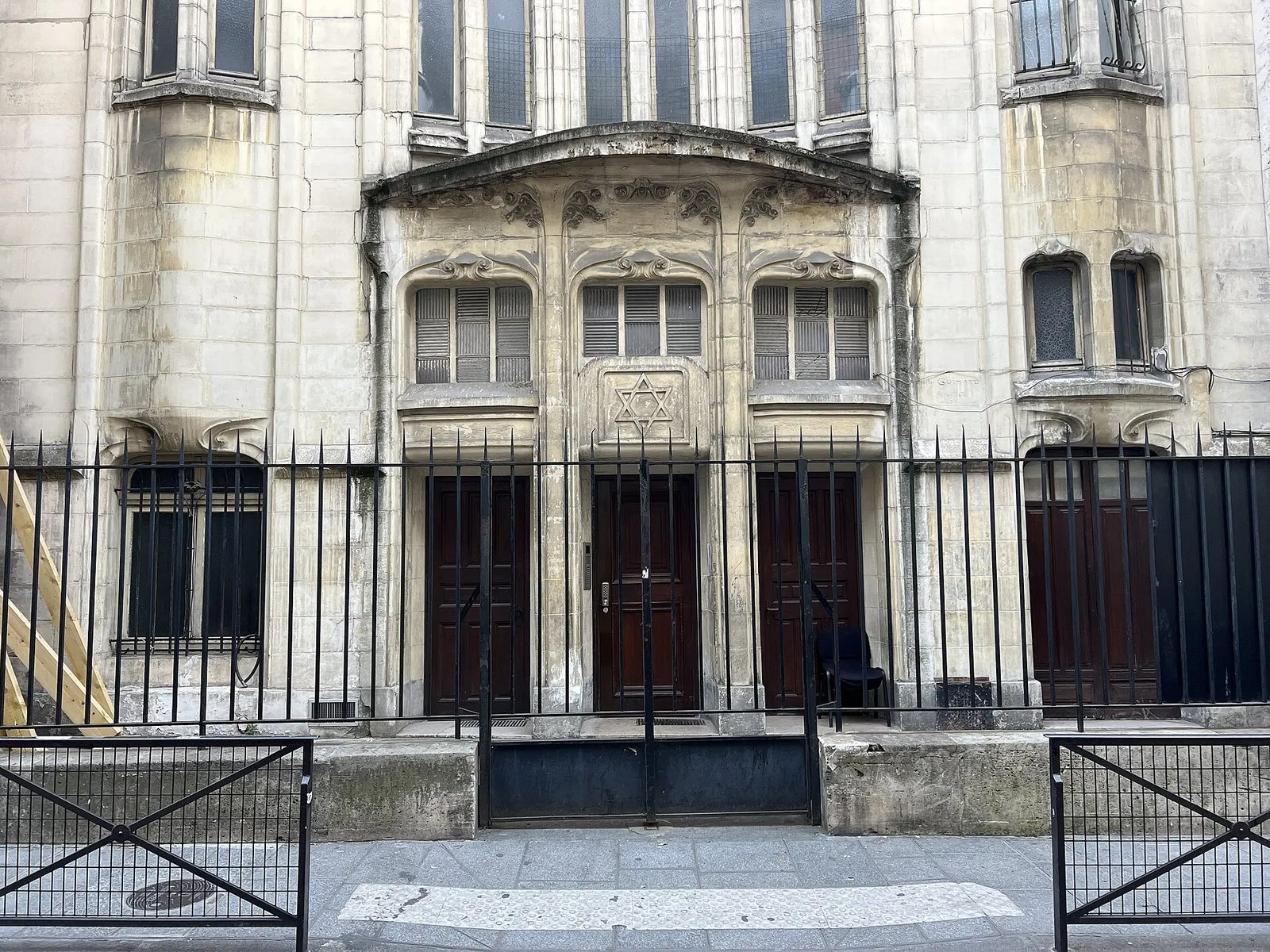
Photo: Chabe01, CC BY-SA 4.0, via Wikimedia Commons

Where to sleep
Our hotels ranked by distance from rue des Rosiers are in our hotels near rue des Rosiers. The closest is Hôtel Dupond-Smith, 184 m away as the crow flies; the page on hotels in the 4th arrondissement covers the rest.
History and distinctive features
- The synagogue on rue Pavée, at number 10, an Art Nouveau work by Hector Guimard built in 1913, was dynamited on the night of 2 to 3 October 1941, during the Yom Kippur vigil, by far-right collaborators, according to Wikipedia, and later partly restored; it is a listed historic monument. Source : fr.wikipedia.org
- The Jardin des Rosiers–Joseph-Migneret, hidden in the middle of the block, opens at 10 rue des Rosiers and through the courtyard of the Hôtel de Coulanges, 35-37 rue des Francs-Bourgeois. Source : fr.wikipedia.org
- Rue Sainte-Croix-de-la-Bretonnerie, 330 m long, has been the historic heart of the LGBT+ Marais since the 1980s, with bars, restaurants and bookshops. Source : fr.wikipedia.org
Frequently asked questions
Where is the Jewish quarter of Le Marais?
In the northern part of the Saint-Gervais administrative district, in the 4th arrondissement: rue des Francs-Bourgeois to the north, rue Vieille-du-Temple and rue du Temple to the west, rue Malher and rue Pavée to the east, rue du Roi-de-Sicile and rue de Rivoli to the south. It is a customary division, not an administrative one.
Why is it called the Pletzl?
Our sources use the name for the historic Jewish quarter, whose heart is rue des Rosiers, but give no origin for it, so we do not explain it here.
Is Sunday or Saturday the better day to visit?
Sunday is the busy day: rue des Rosiers is pedestrian then, as it has been since 2006. Kosher businesses follow the Shabbat rhythm and are often closed from Friday evening to Saturday evening. Check hours shop by shop.
Can shops open on Sunday?
Yes. The whole area lies in the « Le Marais » international tourist zone, where shops may open on Sundays and in the evening.
Which metro station should I use?
Saint-Paul (line 1) is the closest; you can also get off at Hôtel de Ville (lines 1 and 11), Rambuteau (line 11) or Pont Marie (line 7).
What does Pletzl mean?
It is Yiddish for “little square”. It names the historic Jewish quarter of the Marais, organised around the place Saint-Paul, according to Wikipedia.
Which museums belong to the Jewish quarter?
The Museum of Jewish Art and History, 508 metres from the rue des Rosiers, and the Shoah Memorial, 346 metres away. Both are described on their own pages.
What happened to the synagogue on the rue Pavée?
It was built by Hector Guimard in 1913, dynamited on the night of 2 to 3 October 1941, during the Yom Kippur vigil, by far-right collaborators, then partly restored; it has been a listed monument since 1989.
Which metro station is nearest to the Jewish quarter?
Saint-Paul, on line 1, about 239 metres from the middle of the rue des Rosiers in a straight line. Hôtel de Ville, on lines 1 and 11, is about 580 metres away.
Is the Jewish quarter of Le Marais open on Saturdays?
The streets are, but many kosher shops and restaurants close from late Friday afternoon to Saturday evening, and the Shoah Memorial is closed all Saturday. The fashion boutiques stay open.